<?xml version='1.0'?>
<!DOCTYPE art SYSTEM 'http://www.biomedcentral.com/xml/article.dtd'>
<art>
   <ui>1556-276X-4-281</ui>
   <ji>1556-276X</ji>
   <fm>
      <dochead>Nano Express</dochead>
      <bibl>
         <title>
            <p>Mono-dispersed Functional Polymeric Nanocapsules with Multi-lacuna via Soapless Microemulsion Polymerization with Spindle-like &#945;-Fe<sub>2</sub>O<sub>3</sub>Nanoparticles as Templates</p>
         </title>
         <aug>
            <au id="A1"><snm>Liu</snm><fnm>Guangfeng</fnm><insr iid="I1"/></au>
            <au ca="yes" id="A2"><snm>Liu</snm><fnm>Peng</fnm><insr iid="I1"/><email>pliu@lzu.edu.cn</email></au>
         </aug>
         <insg>
            <ins id="I1"><p>State Key Laboratory of Applied Organic Chemistry and Institute of Polymer Science and Engineering, College of Chemistry and Chemical Engineering, Lanzhou University, Lanzhou, 730000, People&#8217;s Republic of China</p></ins>
         </insg>
         <source>Nanoscale Research Letters</source>
         <publisher>Springer-Verlag, New York</publisher>
         <issn>1556-276X</issn>
         <pubdate>2009</pubdate>
         <volume>4</volume>
         <issue>3</issue>
         <fpage>281</fpage>
         <lpage>285</lpage>
         <xrefbib><pubidlist><pubid idtype="pmpid">20596437</pubid><pubid idtype="doi">10.1007/s11671-008-9238-x</pubid></pubidlist></xrefbib>
      </bibl>
      <history><rec><date><day>29</day><month>9</month><year>2008</year></date></rec><acc><date><day>19</day><month>12</month><year>2008</year></date></acc><pub><date><day>6</day><month>1</month><year>2009</year></date></pub></history>
      <cpyrt><year>2008</year><collab>to the authors</collab></cpyrt>
      <kwdg>
         <kwd>Crosslinked polymeric nanocapsules</kwd>
         <kwd>Multi-lacuna</kwd>
         <kwd>Functional surface</kwd>
         <kwd>Soapless microemulsion</kwd>
         <kwd>Template</kwd>
         <kwd>Fe<sub>2</sub>O<sub>3</sub>spindle</kwd>
      </kwdg>
      <abs>
         <sec>
            <st>
               <p>Abstract</p>
            </st>
            <p>The mono-dispersed crosslinked polymeric multi-lacuna nanocapsules (CP(St&#8211;OA) nanocapsules) about 40 nm with carboxylic groups on their inner and outer surfaces were fabricated in the present work. The small conglomerations of the oleic acid modified spindle-like &#945;-Fe<sub>2</sub>O<sub>3</sub>nanoparticles (OA&#8211;Fe<sub>2</sub>O<sub>3</sub>) were encapsulated in the facile microemulsion polymerization with styrene (St) as monomer and divinyl benzene (DVB) as crosslinker. Then the templates, small conglomerations of OA&#8211;Fe<sub>2</sub>O<sub>3</sub>, were etched with HCl in tetrahydrofuran (THF). The surface carboxylic groups of the crosslinked polymeric multi-lacuna nanocapsules were validated by the Zeta potential analysis.</p>
         </sec>
      </abs>
   </fm>
   <meta>
      <classifications>
         <classification subtype="Primary" type="springerjournalsubject">Material Science</classification>
         <classification subtype="Secondary" type="springerjournalsubject">Molecular Medicine</classification>
         <classification subtype="Secondary" type="springerjournalsubject">Engineering, general</classification>
         <classification subtype="Secondary" type="springerjournalsubject">Chemistry/Food Science, general</classification>
         <classification subtype="Secondary" type="springerjournalsubject">Physics, general</classification>
         <classification subtype="Secondary" type="springerjournalsubject">Materials Science, general</classification>
         <classification subtype="Secondary" type="springerjournalsubject">Nanotechnology</classification>
      </classifications>
   </meta>
   <bdy>
      <sec>
         <st>
            <p>Introduction</p>
         </st>
         <p>Most recently, polymeric nanocapsules have attracted more and more attention because of their specific properties and applications, such as drug delivery <abbrgrp><abbr bid="B1">1</abbr>
            <abbr bid="B2">2</abbr>
            <abbr bid="B3">3</abbr>
            <abbr bid="B4">4</abbr></abbrgrp>, catalysts <abbrgrp><abbr bid="B5">5</abbr>
            <abbr bid="B6">6</abbr></abbrgrp>, light-emitting diodes <abbrgrp>
               <abbr bid="B7">7</abbr>
            </abbrgrp>, probing single-cell signaling <abbrgrp>
               <abbr bid="B8">8</abbr>
            </abbrgrp>, self-healing materials <abbrgrp>
               <abbr bid="B9">9</abbr>
            </abbrgrp>, and so on.</p>
         <p>By now, a variety of physical and chemical strategies have been developed for the preparation of polymeric nanocapsules such as template method <abbrgrp><abbr bid="B10">10</abbr>
            <abbr bid="B11">11</abbr>
            <abbr bid="B12">12</abbr>
            <abbr bid="B13">13</abbr>
            <abbr bid="B14">14</abbr>
            <abbr bid="B15">15</abbr>
            <abbr bid="B16">16</abbr>
            <abbr bid="B17">17</abbr></abbrgrp>, micelle method <abbrgrp><abbr bid="B18">18</abbr>
            <abbr bid="B19">19</abbr>
            <abbr bid="B20">20</abbr>
            <abbr bid="B21">21</abbr></abbrgrp>, emulsion polymerization <abbrgrp><abbr bid="B22">22</abbr>
            <abbr bid="B23">23</abbr>
            <abbr bid="B24">24</abbr></abbrgrp>, interfacial polymerization <abbrgrp><abbr bid="B25">25</abbr>
            <abbr bid="B26">26</abbr>
            <abbr bid="B27">27</abbr></abbrgrp>, and other methods <abbrgrp><abbr bid="B28">28</abbr>
            <abbr bid="B29">29</abbr>
            <abbr bid="B30">30</abbr>
            <abbr bid="B31">31</abbr></abbrgrp>. In most of the polymeric nanocapsules reported, the single voided cavum in the nanocapsules were globose. Furthermore, the surface-modification procedure is important to introduce some functional groups onto their inner and/or outer surfaces so that the functional polymeric nanocapsules were achieved.</p>
         <p>In the present work, we developed a facile strategy for the crosslinked polymeric multi-lacuna nanocapsules (CP(St&#8211;OA) nanocapsules) about 40 nm with carboxylic groups on their inner and outer surfaces. The spindle-like &#945;-Fe<sub>2</sub>O<sub>3</sub>nanoparticles were organo-modified with oleic acid (OA) and the oleic acid modified spindle-like &#945;-Fe<sub>2</sub>O<sub>3</sub>nanoparticles (OA&#8211;Fe<sub>2</sub>O<sub>3</sub>) formed the small conglomerations in water. Then the small conglomerations were used as the templates for the soapless microemulsion polymerization. The small conglomerations of OA&#8211;Fe<sub>2</sub>O<sub>3</sub>were encapsulated in the crosslinked polymer nanoparticles obtained. Then the crosslinked polymeric multi-lacuna nanocapsules (CP(St&#8211;OA) nanocapsules) with carboxylic groups on their inner and outer surfaces were achieved after the templates were etched with HCl in tetrahydrofuran (THF).</p>
      </sec>
      <sec>
         <st>
            <p>Experimental Section</p>
         </st>
         <sec>
            <st>
               <p>Materials</p>
            </st>
            <p>The raphidian nano-crystal &#945;-Fe<sub>2</sub>O<sub>3</sub>(TR-708-5W) is obtained from Shangyu Zhengqi Chemical Engineering Co. Ltd., Zhejiang, China. It was dried in vacuum at 110 &#176;C for 48 h before use.</p>
            <p>Oleic acid (OA) and divinyl benzene (DVB) (analytical reagents, Tianjin Chemicals Co. Ltd., China) were used as received without any further treatment. Styrene (St, analytical reagent, Tianjin Chemicals Co. Ltd., China) was dried over CaH<sub>2</sub>and distilled under reduced pressure. Ammonium persulfate (APS, Tianjin Chemicals Co. Ltd., China) was re-crystallized from ethanol before use. The other reagents, THF, ethanol, and concentrated hydrochloric acid (HCl), used were analytical reagent. Double-distilled water was used throughout.</p>
         </sec>
         <sec>
            <st>
               <p>Soapless Emulsion Polymerization</p>
            </st>
            <p>After 100 mL water and 0.1 g &#945;-Fe<sub>2</sub>O<sub>3</sub>was mixed and stirred with electromagnetic stirrer for 20 min, 0.10 mL (0.315 mmol) oleic acid (OA) and 0.0142 g (0.355 mmol) sodium hydroxide (NaOH) were added for another 15 min. Then 1.0 mL St, 0.20 mL DVB and 0.013 g ammonium persulfate (APS) (1.0%) were charged into the dispersoid. The mixture was heated to 70 &#176;C and maintained the temperature for 10 h with electromagnetic stirring. Another 0.013 g APS was added after the first 5 h of the soapless microemulsion polymerization.</p>
            <p>After the brown dispersoid was cooled to the room temperature, the brown product, &#945;-Fe<sub>2</sub>O<sub>3</sub>encapsulated with crosslinked polymer nanoparticles (Fe<sub>2</sub>O<sub>3</sub>/CP(St&#8211;OA)), was separated by being centrifuged at 8000 rps for 10 min and dried at 40 &#176;C under vacuum.</p>
         </sec>
         <sec>
            <st>
               <p>CP(St&#8211;OA) Nanocapsules</p>
            </st>
            <p>The crosslinked polymeric multi-lacuna nanocapsules (CP(St&#8211;OA) nanocapsules) were achieved by the etching of the small conglomerations of OA&#8211;Fe<sub>2</sub>O<sub>3</sub>encapsulated in the crosslinked polymer nanoparticles (Fe<sub>2</sub>O<sub>3</sub>/CP(St&#8211;OA)) by the following process: 0.10 g Fe<sub>2</sub>O<sub>3</sub>/CP(St&#8211;OA) nanoparticles was dispersed into 10 mL THF containing 1.0 mL concentrated hydrochloric acid (HCl) with ultrasonic irradiation. The solid content was separated by being centrifuged at 8000 rps for 10 min after being immersed for 24 h. The etching process was conducted for another time to remove the templates completely. After the remained products were washed with diluted HCl several times, they were washed to neutrality with water.</p>
         </sec>
         <sec>
            <st>
               <p>Characterization</p>
            </st>
            <p>A Bruker IFS 66 v/s infrared spectrometer was used for the Fourier transform infrared (FTIR) spectroscopy analysis. The mean particle size of the Fe<sub>2</sub>O<sub>3</sub>/CP(St&#8211;OA) nanoparticles was conducted with BI-200SM laser light scattering system (LLS, Brookhaven Instruments Co., Holtsville, NY). The morphologies of the nanoparticles and nanocapsules were characterized with a JEM-1200 EX/S transmission electron microscope (TEM). The nanoparticles and nanocapsules were dispersed into water and deposited on a copper grid covered with a perforated carbon film. The Zeta potentials of the nanocapsules at different pH values were determined with Zetasizer Nano ZS (Malvern Instruments Ltd, UK).</p>
         </sec>
      </sec>
      <sec>
         <st>
            <p>Results and Discussion</p>
         </st>
         <p>Oleic acid (OA) with a formula of C<sub>18</sub>H<sub>34</sub>O<sub>2</sub> (or CH<sub>3</sub>(CH<sub>2</sub>)<sub>7</sub>CH=CH(CH<sub>2</sub>)<sub>7</sub>COOH) is a monounsaturated omega-9 fatty acid found in various animal and vegetable sources. It is widely used as surfactant for the soapless seeds emulsion polymerization in the recent years <abbrgrp><abbr bid="B32">32</abbr>
            <abbr bid="B33">33</abbr>
            <abbr bid="B34">34</abbr>
            <abbr bid="B35">35</abbr>
            <abbr bid="B36">36</abbr></abbrgrp>. It could form mono-molecular or bi-molecular layer on the surfaces of the inorganic nanoparticles via its carboxyl groups and the C=C group could copolymerize with the vinyl monomers. So it acts as an interlinkage between the inorganic cores and the polymer shells.</p>
         <p>In the present work, oleic acid was used for the surface modification of the spindle-like &#945;-Fe<sub>2</sub>O<sub>3</sub>nanoparticles. It could be found that the oleic acid modified &#945;-Fe<sub>2</sub>O<sub>3</sub>nanoparticles (OA&#8211;Fe<sub>2</sub>O<sub>3</sub>) had dispersed better than the bare &#945;-Fe<sub>2</sub>O<sub>3</sub>nanoparticles (Fig. <figr fid="F1">1</figr>a and b). The &#945;-Fe<sub>2</sub>O<sub>3</sub>nanoparticles formed the small conglomerations composed with several pieces of &#945;-Fe<sub>2</sub>O<sub>3</sub>nanoparticles in water. The OA formed bi-molecular layers on the surfaces of the small conglomerations as shown in Scheme <schemer cid="C1">1</schemer>.</p>
<fig id="F1"><title><p>Figure 1</p></title><text>
   <p>TEM images</p>
</text><graphic file="1556-276X-4-281-1"/></fig>
<scheme id="C1">
<title>
<p>Scheme 1</p>
</title>
<text><p>Schematic illustration of the formation of the mono-dispersed functional crosslinked polymeric multi-lacuna nanocapsules</p></text>

<graphic file="1556-276X-4-281-i1.gif"/>

</scheme>
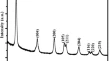
<p>After the polymerization of the monomer St and the crosslinker DVB added, the crosslinked polymer shells were obtained to encapsulate the small conglomerations as templates. The carboxyl groups were decorated onto the surfaces of the &#945;-Fe<sub>2</sub>O<sub>3</sub>nanoparticles encapsulated in the crosslinked polymer nanoparticles (Fe<sub>2</sub>O<sub>3</sub>/CP(St&#8211;OA)) via the copolymerization of OA. The small conglomerations of the &#945;-Fe<sub>2</sub>O<sub>3</sub>nanoparticles were found in the Fe<sub>2</sub>O<sub>3</sub>/CP(St&#8211;OA) (Fig. <figr fid="F1">1</figr>c) and the electron diffractometry (ED) of the &#945;-Fe<sub>2</sub>O<sub>3</sub>nanoparticles in the (Fe<sub>2</sub>O<sub>3</sub>/CP(St&#8211;OA) confirmed it (Fig. <figr fid="F2">2</figr>). Its average particle size was found to be 163.5 nm by the LLS analysis.</p>
         <fig id="F2"><title><p>Figure 2</p></title><text>
   <p>ED of Fe<sub>2</sub>O<sub>3</sub>/CP(St&#8211;OA) nanoparticles</p>
</text><graphic file="1556-276X-4-281-2"/></fig>
         <p>Then the Fe<sub>2</sub>O<sub>3</sub>/CP(St&#8211;OA) nanoparticles were dispersed in THF and treated with HCl to remove the small conglomerations of the &#945;-Fe<sub>2</sub>O<sub>3</sub>nanoparticles. The products were near white after the etching procedure. The characteristic IR bands of &#945;-Fe<sub>2</sub>O<sub>3</sub>nanoparticles at 449 and 532 cm<sup>&#8722;1</sup>disappeared in the Ft-IR spectrum of the CP(St&#8211;OA) nanocapsules (Fig. <figr fid="F3">3</figr>). And the electron diffractometry (ED) of the &#945;-Fe<sub>2</sub>O<sub>3</sub>could not be observed in the CP(St&#8211;OA) nanocapsules. They indicated that the &#945;-Fe<sub>2</sub>O<sub>3</sub>nanoparticles had been removed completely.</p>
         <fig id="F3"><title><p>Figure 3</p></title><text>
   <p>FT-IR spectra of the Fe<sub>2</sub>O<sub>3</sub>/CP(St&#8211;OA) nanoparticles and the CP(St&#8211;OA) nanocapsules</p>
</text><graphic file="1556-276X-4-281-3"/></fig>
         <p>The TEM images of the CP(St&#8211;OA) nanocapsules were given in Fig. <figr fid="F1">1</figr>d. The multi-lacuna structures were found in the CP(St&#8211;OA) nanocapsules with particle size of about 40 nm. They were near mono-dispersed. Compared with the structures and particle size of the Fe<sub>2</sub>O<sub>3</sub>/CP(St&#8211;OA) nanoparticles, the voided cavum were in the center of the nanocapsules. It could be predicated that the crosslinked polymer shells had reset and shrank in the etching period in THF.</p>
         <p>The effects of pH value on the zeta potentials of the crosslinked polymeric multi-lacuna nanocapsules (CP(St&#8211;OA) nanocapsules) are illustrated in Fig. <figr fid="F4">4</figr>. In the studied pH range, the CP(St&#8211;OA) nanocapsules showed the negative zeta potential. This indicated that the surfaces of the silica nano-sheets were negative charged in the pH range. Continuously increasing the pH value to the basic condition, the absolute value of its zeta potential increased. It validated the presence of the carboxyl groups on the surfaces of the CP(St&#8211;OA) nanocapsules, as illustrated in Scheme <schemer cid="C1">1</schemer>. The surface functional groups are expected to extend the applications of the polymeric nanocapsules.</p>
         <fig id="F4"><title><p>Figure 4</p></title><text>
   <p>Zeta potential of the CP(St&#8211;OA) nanocapsules</p>
</text><graphic file="1556-276X-4-281-4"/></fig>
      </sec>
      <sec>
         <st>
            <p>Conclusions</p>
         </st>
         <p>In summary, we developed a facile strategy for the preparation of the mono-dispersed crosslinked polymeric multi-lacuna nanocapsules with functional groups on the inner and outer surfaces via the soapless microemulsion polymerization technique. Their structures, surface functional group and particle size could be altered by changing the inorganic oxide nano-cores, the surfmer (polymerizable surfactant) used and the formula of the polymerization. The technique is expected to extend the applications of the polymeric nanocapsules.</p>
      </sec>
   </bdy>
   <bm>
      <ack>
         <sec>
            <st>
               <p>Acknowledgment</p>
            </st>
            <p>This Project was granted financial support from China Postdoctoral Science Foundation (Grant No. 20070420756).</p>
         </sec>
      </ack>
      <refgrp><bibl id="B1"><aug><au><snm>Mosqueira</snm><fnm>VCF</fnm></au><au><snm>Legrand</snm><fnm>P</fnm></au><au><snm>Barratt</snm><fnm>G</fnm></au></aug><source>J. Nanosci. Nanotechnol.</source><pubdate>2006</pubdate><volume>6</volume><fpage>3193</fpage><note>COI number [1:CAS:528:DC%2BD28XhtVKnsr3F]</note><xrefbib><pubid idtype="doi">10.1166/jnn.2006.444</pubid></xrefbib></bibl><bibl id="B2"><aug><au><snm>Tonoi</snm><fnm>H</fnm></au><au><snm>Matsuzaki</snm><fnm>T</fnm></au><au><snm>Jung</snm><fnm>J</fnm></au><au><snm>Tanizawa</snm><fnm>K</fnm></au><au><snm>Kuroda</snm><fnm>S</fnm></au></aug><source>Nanomedicine NBM</source><pubdate>2007</pubdate><volume>3</volume><fpage>348</fpage></bibl><bibl id="B3"><aug><au><snm>Sablon</snm><fnm>K</fnm></au></aug><source>Nanoscale Res. Lett.</source><pubdate>2008</pubdate><volume>3</volume><fpage>265</fpage><note>COI number [1:CAS:528:DC%2BD1cXhsVyhtrzE]; Bibcode number [2008NRL.....3..265S]</note><xrefbib><pubid idtype="doi">10.1007/s11671-008-9145-1</pubid></xrefbib></bibl><bibl id="B4"><aug><au><snm>Wang</snm><fnm>YJ</fnm></au><au><snm>Bansal</snm><fnm>V</fnm></au><au><snm>Zelikin</snm><fnm>AN</fnm></au><au><snm>Caruso</snm><fnm>F</fnm></au></aug><source>Nano Lett.</source><pubdate>2008</pubdate><volume>8</volume><fpage>1741</fpage><note>COI number [1:CAS:528:DC%2BD1cXmtVaqtL4%3D]; Bibcode number [2008NanoL...8.1741W]</note><xrefbib><pubid idtype="doi">10.1021/nl080877c</pubid></xrefbib></bibl><bibl id="B5"><aug><au><snm>Lawson</snm><fnm>GE</fnm></au><au><snm>Lee</snm><fnm>Y</fnm></au><au><snm>Raushel</snm><fnm>FM</fnm></au><au><snm>Singh</snm><fnm>A</fnm></au></aug><source>Adv. Funct. Mater.</source><pubdate>2005</pubdate><volume>15</volume><fpage>267</fpage><note>COI number [1:CAS:528:DC%2BD2MXitl2qt7s%3D]</note><xrefbib><pubid idtype="doi">10.1002/adfm.200400153</pubid></xrefbib></bibl><bibl id="B6"><aug><au><snm>Miao</snm><fnm>SD</fnm></au><au><snm>Zhang</snm><fnm>CL</fnm></au><au><snm>Liu</snm><fnm>ZM</fnm></au><au><snm>Han</snm><fnm>BX</fnm></au><au><snm>Xie</snm><fnm>Y</fnm></au><au><snm>Ding</snm><fnm>SJ</fnm></au><au><snm>Yang</snm><fnm>ZZ</fnm></au></aug><source>J. Phys. Chem. C</source><pubdate>2008</pubdate><volume>112</volume><fpage>774</fpage><note>COI number [1:CAS:528:DC%2BD1cXitlajuw%3D%3D]</note><xrefbib><pubid idtype="doi">10.1021/jp076596v</pubid></xrefbib></bibl><bibl id="B7"><aug><au><snm>Heo</snm><fnm>JS</fnm></au><au><snm>Park</snm><fnm>NH</fnm></au><au><snm>Ryu</snm><fnm>JH</fnm></au><au><snm>Suh</snm><fnm>KD</fnm></au></aug><source>Adv. Mater.</source><pubdate>2005</pubdate><volume>17</volume><fpage>822</fpage><note>COI number [1:CAS:528:DC%2BD2MXjsFWitL8%3D]</note><xrefbib><pubid idtype="doi">10.1002/adma.200400051</pubid></xrefbib></bibl><bibl id="B8"><aug><au><snm>Sun</snm><fnm>BY</fnm></au><au><snm>Chiu</snm><fnm>DT</fnm></au></aug><source>Langmuir</source><pubdate>2004</pubdate><volume>20</volume><fpage>4614</fpage><note>COI number [1:CAS:528:DC%2BD2cXjt1Gjt7c%3D]</note><xrefbib><pubid idtype="doi">10.1021/la0364340</pubid></xrefbib></bibl><bibl id="B9"><aug><au><snm>Blaiszik</snm><fnm>BJ</fnm></au><au><snm>Sottos</snm><fnm>NR</fnm></au><au><snm>White</snm><fnm>SR</fnm></au></aug><source>Compos. Sci. Technol.</source><pubdate>2008</pubdate><volume>68</volume><fpage>978</fpage><note>COI number [1:CAS:528:DC%2BD1cXhsFWls7w%3D]</note><xrefbib><pubid idtype="doi">10.1016/j.compscitech.2007.07.021</pubid></xrefbib></bibl><bibl id="B10"><aug><au><snm>Marinakos</snm><fnm>SM</fnm></au><au><snm>Novak</snm><fnm>JP</fnm></au><au><snm>Brousseau</snm><fnm>LC</fnm></au><au><snm>House</snm><fnm>AB</fnm></au><au><snm>Edeki</snm><fnm>EM</fnm></au><au><snm>Feldhaus</snm><fnm>JC</fnm></au><au><snm>Feldheim</snm><fnm>DL</fnm></au></aug><source>J. Am. Chem. Soc.</source><pubdate>1999</pubdate><volume>121</volume><fpage>8518</fpage><note>COI number [1:CAS:528:DyaK1MXlsFSrsL4%3D]</note><xrefbib><pubid idtype="doi">10.1021/ja990945k</pubid></xrefbib></bibl><bibl id="B11"><aug><au><snm>Marinakos</snm><fnm>SM</fnm></au><au><snm>Shultz</snm><fnm>DA</fnm></au><au><snm>Feldheim</snm><fnm>DL</fnm></au></aug><source>Adv. Mater.</source><pubdate>1999</pubdate><volume>11</volume><fpage>34</fpage><note>COI number [1:CAS:528:DyaK1MXjsFChtg%3D%3D]</note><xrefbib><pubid idtype="doi">10.1002/(SICI)1521-4095(199901)11:1&lt;34::AID-ADMA34&gt;3.0.CO;2-I</pubid></xrefbib></bibl><bibl id="B12"><aug><au><snm>Gittins</snm><fnm>DI</fnm></au><au><snm>Caruso</snm><fnm>F</fnm></au></aug><source>Adv. Mater.</source><pubdate>2000</pubdate><volume>12</volume><fpage>1947</fpage><note>COI number [1:CAS:528:DC%2BD3MXhtVaksbY%3D]</note><xrefbib><pubid idtype="doi">10.1002/1521-4095(200012)12:24&lt;1947::AID-ADMA1947&gt;3.0.CO;2-8</pubid></xrefbib></bibl><bibl id="B13"><aug><au><snm>Mandal</snm><fnm>TK</fnm></au><au><snm>Fleming</snm><fnm>MS</fnm></au><au><snm>Walt</snm><fnm>DR</fnm></au></aug><source>Chem. Mater.</source><pubdate>2000</pubdate><volume>12</volume><fpage>3481</fpage><note>COI number [1:CAS:528:DC%2BD3cXns1Ojurk%3D]</note><xrefbib><pubid idtype="doi">10.1021/cm000514x</pubid></xrefbib></bibl><bibl id="B14"><aug><au><snm>Schneider</snm><fnm>G</fnm></au><au><snm>Decher</snm><fnm>G</fnm></au></aug><source>Nano Lett.</source><pubdate>2004</pubdate><volume>4</volume><fpage>1833</fpage><note>COI number [1:CAS:528:DC%2BD2cXnsVahsLc%3D]; Bibcode number [2004NanoL...4.1833S]</note><xrefbib><pubid idtype="doi">10.1021/nl0490826</pubid></xrefbib></bibl><bibl id="B15"><aug><au><snm>Da Silva Gomes</snm><fnm>JFP</fnm></au><au><snm>Sonnen</snm><fnm>AFP</fnm></au><au><snm>Kronenberger</snm><fnm>A</fnm></au><au><snm>Fritz</snm><fnm>J</fnm></au><au><snm>Coelho</snm><fnm>MAN</fnm></au><au><snm>Fournier</snm><fnm>D</fnm></au><au><snm>Fournier-Noel</snm><fnm>C</fnm></au><au><snm>Mauzac</snm><fnm>M</fnm></au><au><snm>Winterhalter</snm><fnm>M</fnm></au></aug><source>Langmuir</source><pubdate>2006</pubdate><volume>22</volume><fpage>7755</fpage><note>COI number [1:CAS:528:DC%2BD28Xntl2gtrc%3D]</note><xrefbib><pubid idtype="doi">10.1021/la0613575</pubid></xrefbib></bibl><bibl id="B16"><aug><au><snm>Schwiertz</snm><fnm>J</fnm></au><au><snm>Meyer-Zaika</snm><fnm>W</fnm></au><au><snm>Ruiz-Gonzalez</snm><fnm>L</fnm></au><au><snm>Gonzalez-Calbet</snm><fnm>JM</fnm></au><au><snm>Vallet-Reqi</snm><fnm>M</fnm></au><au><snm>Epple</snm><fnm>M</fnm></au></aug><source>J. Mater. Chem.</source><pubdate>2008</pubdate><volume>18</volume><fpage>3831</fpage><note>COI number [1:CAS:528:DC%2BD1cXptlyrurg%3D]</note><xrefbib><pubid idtype="doi">10.1039/b803609h</pubid></xrefbib></bibl><bibl id="B17"/><bibl id="B18"><aug><au><snm>Jang</snm><fnm>J</fnm></au><au><snm>Ha</snm><fnm>H</fnm></au></aug><source>Langmuir</source><pubdate>2002</pubdate><volume>18</volume><fpage>5613</fpage><note>COI number [1:CAS:528:DC%2BD38XksFagsr4%3D]</note><xrefbib><pubid idtype="doi">10.1021/la0257283</pubid></xrefbib></bibl><bibl id="B19"><aug><au><snm>Hu</snm><fnm>Y</fnm></au><au><snm>Jiang</snm><fnm>XQ</fnm></au><au><snm>Ding</snm><fnm>Y</fnm></au><au><snm>Chen</snm><fnm>Q</fnm></au><au><snm>Yang</snm><fnm>CZ</fnm></au></aug><source>Adv. Mater.</source><pubdate>2004</pubdate><volume>16</volume><fpage>933</fpage><note>COI number [1:CAS:528:DC%2BD2cXlslektb4%3D]</note><xrefbib><pubid idtype="doi">10.1002/adma.200306579</pubid></xrefbib></bibl><bibl id="B20"><aug><au><snm>Im</snm><fnm>SH</fnm></au><au><snm>Jeong</snm><fnm>U</fnm></au><au><snm>Xia</snm><fnm>YN</fnm></au></aug><source>Nat. Mater.</source><pubdate>2005</pubdate><volume>4</volume><fpage>671</fpage><note>COI number [1:CAS:528:DC%2BD2MXpsFeitb8%3D]; Bibcode number [2005NatMa...4..671H]</note><xrefbib><pubid idtype="doi">10.1038/nmat1448</pubid></xrefbib></bibl><bibl id="B21"><aug><au><snm>Wang</snm><fnm>J</fnm></au><au><snm>Jiang</snm><fnm>M</fnm></au></aug><source>J. Am. Chem. Soc.</source><pubdate>2006</pubdate><volume>128</volume><fpage>3703</fpage><note>COI number [1:CAS:528:DC%2BD28XhvVequ7s%3D]</note><xrefbib><pubid idtype="doi">10.1021/ja056775v</pubid></xrefbib></bibl><bibl id="B22"><aug><au><snm>Sauer</snm><fnm>M</fnm></au><au><snm>Streich</snm><fnm>D</fnm></au><au><snm>Meier</snm><fnm>W</fnm></au></aug><source>Adv. Mater.</source><pubdate>2001</pubdate><volume>13</volume><fpage>16491</fpage><xrefbib><pubid idtype="doi">10.1002/1521-4095(200111)13:21&lt;1649::AID-ADMA1649&gt;3.0.CO;2-E</pubid></xrefbib></bibl><bibl id="B23"><aug><au><snm>Sarkar</snm><fnm>D</fnm></au><au><snm>El-Khoury</snm><fnm>J</fnm></au><au><snm>Lopina</snm><fnm>ST</fnm></au><au><snm>Hu</snm><fnm>J</fnm></au></aug><source>Macromolecules</source><pubdate>2005</pubdate><volume>38</volume><fpage>8603</fpage><note>COI number [1:CAS:528:DC%2BD2MXps1eqtbw%3D]; Bibcode number [2005Mamol..38.8603S]</note><xrefbib><pubid idtype="doi">10.1021/ma050661m</pubid></xrefbib></bibl><bibl id="B24"><aug><au><snm>Zoldesi</snm><fnm>CI</fnm></au><au><snm>Imhof</snm><fnm>A</fnm></au></aug><source>Adv. Mater.</source><pubdate>2006</pubdate><volume>17</volume><fpage>924</fpage><note>COI number [1:CAS:528:DC%2BD2MXjsFWiurY%3D]</note><xrefbib><pubid idtype="doi">10.1002/adma.200401183</pubid></xrefbib></bibl><bibl id="B25"><aug><au><snm>Sun</snm><fnm>QH</fnm></au><au><snm>Deng</snm><fnm>YL</fnm></au></aug><source>J. Am. Chem. Soc.</source><pubdate>2005</pubdate><volume>127</volume><fpage>8274</fpage><note>COI number [1:CAS:528:DC%2BD2MXktlKjtr0%3D]</note><xrefbib><pubid idtype="doi">10.1021/ja051487k</pubid></xrefbib></bibl><bibl id="B26"><aug><au><snm>Wu</snm><fnm>D</fnm></au><au><snm>Scott</snm><fnm>C</fnm></au><au><snm>Ho</snm><fnm>CC</fnm></au><au><snm>Co</snm><fnm>CC</fnm></au></aug><source>Macromolecules</source><pubdate>2006</pubdate><volume>39</volume><fpage>5848</fpage><note>COI number [1:CAS:528:DC%2BD28XntFahu7w%3D]; Bibcode number [2006Mamol..39.5848W]</note><xrefbib><pubid idtype="doi">10.1021/ma060951i</pubid></xrefbib></bibl><bibl id="B27"><aug><au><snm>Yang</snm><fnm>S</fnm></au><au><snm>Liu</snm><fnm>HR</fnm></au></aug><source>J. Mater. Chem.</source><pubdate>2006</pubdate><volume>16</volume><fpage>4480</fpage><note>COI number [1:CAS:528:DC%2BD28Xht1antrnP]</note><xrefbib><pubid idtype="doi">10.1039/b612013j</pubid></xrefbib></bibl><bibl id="B28"><aug><au><snm>Jang</snm><fnm>J</fnm></au><au><snm>Oh</snm><fnm>JH</fnm></au><au><snm>Li</snm><fnm>XL</fnm></au></aug><source>J. Mater. Chem.</source><pubdate>2004</pubdate><volume>14</volume><fpage>2827</fpage><note>COI number [1:CAS:528:DC%2BD2cXnvFCgu7s%3D]</note><xrefbib><pubid idtype="doi">10.1039/b405607h</pubid></xrefbib></bibl><bibl id="B29"><aug><au><snm>Kim</snm><fnm>D</fnm></au><au><snm>Kim</snm><fnm>E</fnm></au><au><snm>Kim</snm><fnm>J</fnm></au><au><snm>Park</snm><fnm>KM</fnm></au><au><snm>Baek</snm><fnm>K</fnm></au><au><snm>Jung</snm><fnm>M</fnm></au><au><snm>Ko</snm><fnm>YH</fnm></au><au><snm>Sung</snm><fnm>W</fnm></au><au><snm>Kim</snm><fnm>HS</fnm></au><au><snm>Suh</snm><fnm>JH</fnm></au><au><snm>Park</snm><fnm>CG</fnm></au><au><snm>Na</snm><fnm>OS</fnm></au><au><snm>Lee</snm><fnm>DK</fnm></au><au><snm>Lee</snm><fnm>KE</fnm></au><au><snm>Han</snm><fnm>SS</fnm></au><au><snm>Kim</snm><fnm>K</fnm></au></aug><source>Angew. Chem. Int. Ed.</source><pubdate>2007</pubdate><volume>46</volume><fpage>3471</fpage><note>COI number [1:CAS:528:DC%2BD2sXmtV2jtro%3D]</note><xrefbib><pubid idtype="doi">10.1002/anie.200604526</pubid></xrefbib></bibl><bibl id="B30"><aug><au><snm>Liu</snm><fnm>KH</fnm></au><au><snm>Chen</snm><fnm>SY</fnm></au><au><snm>Liu</snm><fnm>DM</fnm></au><au><snm>Liu</snm><fnm>TY</fnm></au></aug><source>Macromolecules</source><pubdate>2008</pubdate><volume>41</volume><fpage>6511</fpage><note>COI number [1:CAS:528:DC%2BD1cXps1aksro%3D]; Bibcode number [2008Mamol..41.6511L]</note><xrefbib><pubid idtype="doi">10.1021/ma8002399</pubid></xrefbib></bibl><bibl id="B31"/><bibl id="B32"><aug><au><snm>Quaroni</snm><fnm>L</fnm></au><au><snm>Chumanov</snm><fnm>G</fnm></au></aug><source>J. Am. Chem. Soc.</source><pubdate>1999</pubdate><volume>121</volume><fpage>10642</fpage><note>COI number [1:CAS:528:DyaK1MXmvFCqsrw%3D]</note><xrefbib><pubid idtype="doi">10.1021/ja992088q</pubid></xrefbib></bibl><bibl id="B33"><aug><au><snm>Morales</snm><fnm>MA</fnm></au><au><snm>Jain</snm><fnm>TK</fnm></au><au><snm>Labhasetwar</snm><fnm>V</fnm></au><au><snm>Leslie-Pelecky</snm><fnm>DL</fnm></au></aug><source>J. Appl. Phys.</source><pubdate>2005</pubdate><volume>97</volume><fpage>10Q905</fpage><note>COI number [1:CAS:528:DC%2BD2MXkvVOgs7o%3D]</note><xrefbib><pubid idtype="doi">10.1063/1.1850855</pubid></xrefbib></bibl><bibl id="B34"><aug><au><snm>Liu</snm><fnm>P</fnm></au></aug><source>Colloid Surf. A: Physicochem. Eng. Asp.</source><pubdate>2006</pubdate><volume>291</volume><fpage>155</fpage><note>COI number [1:CAS:528:DC%2BD28Xht1WltL%2FI]</note><xrefbib><pubid idtype="doi">10.1016/j.colsurfa.2006.05.007</pubid></xrefbib></bibl><bibl id="B35"><aug><au><snm>Xia</snm><fnm>A</fnm></au><au><snm>Hu</snm><fnm>JH</fnm></au><au><snm>Wang</snm><fnm>CC</fnm></au><au><snm>Jiang</snm><fnm>DL</fnm></au></aug><source>Small</source><pubdate>2007</pubdate><volume>3</volume><fpage>1811</fpage><note>COI number [1:CAS:528:DC%2BD2sXhtFyitL7N]</note><xrefbib><pubid idtype="doi">10.1002/smll.200700117</pubid></xrefbib></bibl><bibl id="B36"><aug><au><snm>Chen</snm><fnm>ZP</fnm></au><au><snm>Zhang</snm><fnm>Y</fnm></au><au><snm>Zhang</snm><fnm>S</fnm></au><au><snm>Xia</snm><fnm>JG</fnm></au><au><snm>Liu</snm><fnm>JW</fnm></au><au><snm>Xu</snm><fnm>K</fnm></au><au><snm>Gu</snm><fnm>N</fnm></au></aug><source>Colloid Surf. A: Physicochem. Eng. Asp.</source><pubdate>2008</pubdate><volume>316</volume><fpage>210</fpage><note>COI number [1:CAS:528:DC%2BD1cXhsVCqtLk%3D]</note><xrefbib><pubid idtype="doi">10.1016/j.colsurfa.2007.09.017</pubid></xrefbib></bibl></refgrp>
   </bm>
</art>