<?xml version='1.0'?>
<!DOCTYPE art SYSTEM 'http://www.biomedcentral.com/xml/article.dtd'>
<art>
   <ui>1556-276X-3-431</ui>
   <ji>1556-276X</ji>
   <fm>
      <dochead>Nano Express</dochead>
      <bibl>
         <title>
            <p>Morphology-Controllable Synthesis of CeO<sub>2</sub>on a Pt Electrode</p>
         </title>
         <aug>
            <au id="A1"><snm>Fu</snm><fnm>Y</fnm><insr iid="I1"/><insr iid="I2"/></au>
            <au ca="yes" id="A2"><snm>Wei</snm><fnm>ZD</fnm><insr iid="I1"/><insr iid="I2"/><insr iid="I3"/><email>zdwei@cqu.edu.cn</email></au>
            <au id="A3"><snm>Ji</snm><fnm>MB</fnm><insr iid="I3"/></au>
            <au id="A4"><snm>Li</snm><fnm>L</fnm><insr iid="I3"/></au>
            <au ca="yes" id="A5"><snm>Shen</snm><fnm>PK</fnm><insr iid="I4"/><email>stsspk@sysu.edu.cn</email></au>
            <au id="A6"><snm>Zhang</snm><fnm>J</fnm><insr iid="I3"/></au>
         </aug>
         <insg>
            <ins id="I1"><p>State Key Laboratory of Power Transmission Equipment &amp; System Security and New Technology, Chongqing University, Chongqing, 400044, China</p></ins>
            <ins id="I2"><p>School of Chemistry and Chemical Engineering, Chongqing University, Chongqing, 400044, China</p></ins>
            <ins id="I3"><p>School of Material Science and Engineering, Chongqing University, Chongqing, 400044, China</p></ins>
            <ins id="I4"><p>The State Key Laboratory of Optoelectronic Materials and Technologies, Sun Yat-Sen University, Guangzhou, 510275, China</p></ins>
         </insg>
         <source>Nanoscale Research Letters</source>
         <publisher>Springer-Verlag, New York</publisher>
         <issn>1556-276X</issn>
         <pubdate>2008</pubdate>
         <volume>3</volume>
         <issue>11</issue>
         <fpage>431</fpage>
         <lpage>434</lpage>
         <xrefbib><pubid idtype="doi">10.1007/s11671-008-9177-6</pubid></xrefbib>
      </bibl>
      <history><rec><date><day>13</day><month>8</month><year>2008</year></date></rec><acc><date><day>11</day><month>9</month><year>2008</year></date></acc><pub><date><day>30</day><month>9</month><year>2008</year></date></pub></history>
      <cpyrt><year>2008</year><collab>to the authors</collab></cpyrt>
      <kwdg>
         <kwd>CeO<sub>2</sub>
         </kwd>
         <kwd>Nanorod</kwd>
         <kwd>Nanotube</kwd>
         <kwd>Electrosynthesis</kwd>
      </kwdg>
      <abs>
         <sec>
            <st>
               <p>Abstract</p>
            </st>
            <p>Nanoscale cerium dioxides with shape of nanoparticles, nanorods, and nanotubes were electrochemically synthesized. The morphology of CeO<sub>2</sub>was modulated by changing electrode potential and potential direction. CeO<sub>2</sub>nanorods and CeO<sub>2</sub>nanotubes were synthesized via the potentiostatic and cyclic voltammeteric methods, respectively. The morphology and structure of the obtained CeO<sub>2</sub>were characterized by field emission scanning electron microscope (FESEM) and X-ray diffraction (XRD). A possible formation mechanism has been suggested to illuminate the relationship between the preparation condition and the morphology of CeO<sub>2</sub>.</p>
         </sec>
      </abs>
   </fm>
   <meta>
      <classifications>
         <classification subtype="Primary" type="springerjournalsubject">Chemistry</classification>
         <classification subtype="Secondary" type="springerjournalsubject">Molecular Medicine</classification>
         <classification subtype="Secondary" type="springerjournalsubject">Engineering, general</classification>
         <classification subtype="Secondary" type="springerjournalsubject">Chemistry/Food Science, general</classification>
         <classification subtype="Secondary" type="springerjournalsubject">Physics, general</classification>
         <classification subtype="Secondary" type="springerjournalsubject">Materials Science</classification>
         <classification subtype="Secondary" type="springerjournalsubject">Nanotechnology</classification>
      </classifications>
   </meta>
   <bdy>
      <sec>
         <st>
            <p>Introduction</p>
         </st>
         <p>The one-dimension (1D) nanostructure has attracted much attention since the discovery of carbon nanotubes (CNTs) in 1952 <abbrgrp>
               <abbr bid="B1">1</abbr>
            </abbrgrp> and has offered great potential for applications in the electric devices, sensors, and others uses <abbrgrp>
               <abbr bid="B2">2</abbr>
            </abbrgrp>. Controlled synthesis of inorganic nanoparticles now is one of the important topics in colloid and material chemistry for their shape-dependent properties and potentials of self-assembly as building blocks-artificial atoms with diverse superstructures and mesocrystals <abbrgrp><abbr bid="B3">3</abbr>
            <abbr bid="B4">4</abbr></abbrgrp>. Much effort has been devoted to the design and preparation of nanostructures with different shapes and sizes. The morphology-controllable synthesis of nanostructured metal compounds, such as PbSe <abbrgrp>
               <abbr bid="B5">5</abbr>
            </abbrgrp>, ZnO <abbrgrp><abbr bid="B6">6</abbr>
            <abbr bid="B7">7</abbr></abbrgrp>, In(OH)<sub>3</sub> 
            <abbrgrp>
               <abbr bid="B8">8</abbr>
            </abbrgrp>, SnO<sub>2</sub> 
            <abbrgrp>
               <abbr bid="B9">9</abbr>
            </abbrgrp>, and V<sub>2</sub>O<sub>5</sub> 
            <abbrgrp>
               <abbr bid="B10">10</abbr>
            </abbrgrp>, has been successfully developed.</p>
         <p>As one of the most active rare earth materials, ceria (cerium oxide, CeO<sub>2</sub>) has been extensively used in catalysts, fuel cells, solar cells, and polishing materials <abbrgrp><abbr bid="B11">11</abbr>
            <abbr bid="B12">12</abbr></abbrgrp>. Stimulated by promising applications and the fantastic properties, much attention has been directed to the controlled synthesis of CeO<sub>2</sub> nanostructured materials. Up to now, several strategies have been demonstrated to fabricate CeO<sub>2</sub> nanotubes, such as arc discharge, chemical vapor deposition, template-directed synthesis, and hydrothermal treatment. CeO<sub>2</sub> nanostructured materials with ordered mesoporous cerium oxides <abbrgrp>
               <abbr bid="B13">13</abbr>
            </abbrgrp>, (100) oriented CeO<sub>2</sub> films <abbrgrp>
               <abbr bid="B14">14</abbr>
            </abbrgrp>, nanorods <abbrgrp>
               <abbr bid="B15">15</abbr>
            </abbrgrp>, nanowires <abbrgrp>
               <abbr bid="B16">16</abbr>
            </abbrgrp>, nanotubes <abbrgrp><abbr bid="B17">17</abbr>
            <abbr bid="B18">18</abbr>
            <abbr bid="B19">19</abbr></abbrgrp>, nanocubes <abbrgrp>
               <abbr bid="B20">20</abbr>
            </abbrgrp>, nanospheres <abbrgrp>
               <abbr bid="B21">21</abbr>
            </abbrgrp>, and nanobelts <abbrgrp>
               <abbr bid="B22">22</abbr>
            </abbrgrp> have been reported. Most recently, Han et al. <abbrgrp>
               <abbr bid="B18">18</abbr>
            </abbrgrp> reported the production of ceria nanotubes via a two-step procedure, precipitation at 100 &#176;C and aging at 0 &#176;C for 45 days. Tang et al. <abbrgrp>
               <abbr bid="B19">19</abbr>
            </abbrgrp> also reported layer-structured rolling Ce(OH)<sub>3</sub> nanotubes through an alkali thermal-treatment process under oxygen-free conditions. Evidently, the methods used for synthesis of CeO<sub>2</sub> nanostructured materials are usually complicated and time-consuming. An effective method is necessary for production of high-quality ceria nanotubes in terms of yield, uniformity, and shape control. However, it has been a challenge for the effective synthesis of CeO<sub>2</sub> nanostructured materials so far.</p>
         <p>In this work, we report for the first time one-step synthesis of CeO<sub>2</sub>nanoparticles, nanorods, and nanotubes via an electrochemically synthesized route. The morphology was modulated by changing the electric field, strength, and direction. A possible formation mechanism of CeO<sub>2</sub>nanostructured materials has been suggested to illuminate the relationship between the preparation condition and the morphology of yielded CeO<sub>2</sub>.</p>
      </sec>
      <sec>
         <st>
            <p>Experimental</p>
         </st>
         <sec>
            <st>
               <p>Preparation of CeO<sub>2</sub>Nanostructured Materials</p>
            </st>
            <p>CeO<sub>2</sub>was potentiostatically and cyclic voltammeterically synthesized on a Pt electrode, and accordingly, the synthesized CeO<sub>2</sub>are named as ps-CeO<sub>2</sub>and cv-CeO<sub>2</sub>, respectively. In the potentiostatically synthesized CeO<sub>2</sub>, the Pt electrode potential was kept at 1.2 V (versus KOH saturated Hg/HgO) for a length of 30, 85, and 130 s in a bath of 0.05 M Ce(NO<sub>3</sub>)<sub>3</sub> &#183; 6H<sub>2</sub>O and 0.1 M NH<sub>4</sub>NO<sub>3</sub>at room temperature. The pH of the solution was adjusted to 6 by NH<sub>4</sub>OH. In the cyclic voltammeterically synthesized cerium oxide, CeO<sub>2</sub>was prepared on a Pt electrode by cycling potential between 0.5 and 1.4 V at a sweep rate of 20, 30, and 50 mV s<sup>&#8722;1</sup>, respectively, for 120 min in the same bath as used in the potentiostatical synthesis.</p>
         </sec>
         <sec>
            <st>
               <p>Morphologies Characterization</p>
            </st>
            <p>XRD analysis of CeO<sub>2</sub>was carried out on the D/max-1200 diffractometer (Japan) using a Cu K<it>&#945;</it>X-ray source operating at 45 kV and 100 mA, scanning at the rate of 4&#176;/min with an angular resolution of 0.05&#176; of the 2<it>&#952;</it>scan to get the XRD patterns. The morphologies of the CeO<sub>2</sub>were studied on a FEI Nova 400 field emission scanning electron microscope (FESEM) (Peabody, Netherland).</p>
         </sec>
      </sec>
      <sec>
         <st>
            <p>Results and Discussion</p>
         </st>
         <sec>
            <st>
               <p>Morphologies of Synthesized CeO<sub>2</sub>Nanostructured Materials</p>
            </st>
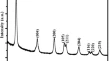
            <p>Figure <figr fid="F1">1</figr> shows the XRD pattern of the synthesized ps-CeO<sub>2</sub> sample. The diffraction peaks corresponding to the different planes of CeO<sub>2</sub> are marked in Fig. <figr fid="F1">1</figr>. The diffraction peaks can be indexed to the face-centered cubic structure of CeO<sub>2</sub> (space group Fm3 m) with a lattice constant of 0.5410 nm according to JCPDS 78-0694 <abbrgrp><abbr bid="B15">15</abbr>
               <abbr bid="B23">23</abbr></abbrgrp>.</p>
            <fig id="F1"><title><p>Figure 1</p></title><text>
   <p>XRD spectrum of ps-CeO<sub>2</sub>prepared at 1.2 V for 30 s</p>
</text><graphic file="1556-276X-3-431-1"/></fig>
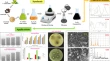
            <p>Figure <figr fid="F2">2</figr> shows the growth history of ps-CeO<sub>2</sub> generated potentiostatically at 1.2 V with different lengths of anodic oxidation. As seen, only a few of nanoparticles with size of 15&#8211;50 nm (measured from the SEM micrograph and consistent with the crystallite size calculated from XRD) are present on the smooth Pt surface as the anodic oxidation lasts for 30 s. When the anodic oxidation lasts for 85 s, more CeO<sub>2</sub> spherical crystallites form. Meanwhile, a clear grain boundary is also observed. It indicates that obtained CeO<sub>2</sub> crystallites are constituted by the oriented aggregation of small CeO<sub>2</sub> nanoparticles. The diameter of the CeO<sub>2</sub> nanoparticles is in the range of 20&#8211;100 nm calculated by statistical software with the FESEM. With the time of anodic oxidation further increasing to 130 s, number of isolated nanoparticles began to reduce, but nanorods are nearly the sole products as illustrated in Fig. <figr fid="F2">2</figr>c, in which CeO<sub>2</sub> nanorods plus many tiny interconnected nanoparticles are present. The similar structure CeO<sub>2</sub> was synthesized previously via ultrasonication approach with aid of polyethylene glycol as a structure-directing agent <abbrgrp>
                  <abbr bid="B15">15</abbr>
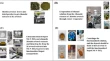
               </abbrgrp>. Figure <figr fid="F3">3</figr> shows morphologies of CeO<sub>2</sub> nanotubes synthesized by the way of CV between 0.5 and 1.4 V at different sweep rates. Figure <figr fid="F3">3</figr> shows the curve degree of CeO<sub>2</sub> nanotubes increases with the potential sweep rate. That is, the curve degree of CeO<sub>2</sub> nanotubes increases with the potential sweep rates from 20, and then 30, and finally to 50 mV s<sup>&#8722;1</sup>, which is really interesting. Nanoscale CeO<sub>2</sub> synthesized potentiostatically has rod-shape morphology, but those synthesized cyclic-voltammeterically has curve-shape morphology. In short, the morphologies of CeO<sub>2</sub> sized in nanoscale from nanoparticles, nanorods, and to nanowires can be fabricated by simply changing the potential direction and time of anodic oxidation. Why does the curve degree of CeO<sub>2</sub> nanotubes increase with potential sweep rates? The following abecedarian mechanism about CeO<sub>2</sub> nanotube growth was suggested.</p>
            <fig id="F2"><title><p>Figure 2</p></title><text>
   <p>FESEM images of ps-CeO<sub>2</sub>prepared at 1.2 V for 30 s (<b>a</b>), 85 s (<b>b</b>), and 130 s (<b>c</b>)</p>
</text><graphic file="1556-276X-3-431-2"/></fig>
            <fig id="F3"><title><p>Figure 3</p></title><text>
   <p>FESEM images of cv-CeO<sub>2</sub>prepared at a sweep rate of 20 mV s<sup>&#8722;1</sup>(<b>a</b>), 30 mV s<sup>&#8722;1</sup>(<b>b</b>), and 50 mV s<sup>&#8722;1</sup>(<b>c</b>) for 2 h</p>
</text><graphic file="1556-276X-3-431-3"/></fig>
         </sec>
         <sec>
            <st>
               <p>Possible Formation Mechanism of CeO<sub>2</sub>Nanotubes</p>
            </st>
            <p>Oxidation of Ce (III) to CeO<sub>2</sub>can be accomplished electrochemically in reaction (1) or chemically in reaction (2). In this work, CeO<sub>2</sub>is synthesized electrochemically.</p>
<p><display-formula id="M1">
<graphic file="1556-276X-3-431-i1.gif"/>
</display-formula></p>
<p><display-formula id="M2"><graphic file="1556-276X-3-431-i2.gif"/>
</display-formula></p>
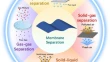
<p>Since an instantaneous nucleation and growth mechanism cannot explain the morphology-controllable synthesis of CeO<sub>2</sub>, the formation of CeO<sub>2</sub>nanorods and nanotubes is assumed to experience the process as illustrated in Fig. <figr fid="F4">4</figr>. The CeO<sub>2</sub>nanoparticles adsorb OH<sup>&#8722;</sup>ions and fuse them together by hydrogen bonding. Adsorbed OH<sup>&#8722;</sup>on the surfaces of CeO<sub>2</sub>will further adsorb Ce<sup>3+</sup>ions, and then OH<sup>&#8722;</sup>and Ce<sup>3+</sup>ions combine to CeO<sub>2</sub>with one electron release. OH<sup>&#8722;</sup>and Ce<sup>3+</sup>ions are electrically adsorbed on the surfaces of CeO<sub>2</sub>in an oriented manner under pulling force of the direct current electric field and fused together. It leads to the formation of CeO<sub>2</sub>nanorods. Thus, if OH<sup>&#8722;</sup>and Ce<sup>3+</sup>ions are electrically adsorbed on the surfaces of CeO<sub>2</sub>under pulling force of a continuously changed electric field direction and fused together, it will certainly lead to the formation of CeO<sub>2</sub>curved nanotubes. The stronger the electric field direction changes, the more frequently the position of adsorbed OH<sup>&#8722;</sup>and Ce<sup>3+</sup>ions on the surfaces of CeO<sub>2</sub>moves, the more curved the CeO<sub>2</sub>nanotubes will be. It is not strange why CeO<sub>2</sub>nanotubes with a different curved degree were generated at different potential sweep rates.</p>
            <fig id="F4"><title><p>Figure 4</p></title><text>
   <p>Possible mechanism of CeO<sub>2</sub>nanorod and nanotubes growth</p>
</text><graphic file="1556-276X-3-431-4"/></fig>
         </sec>
      </sec>
      <sec>
         <st>
            <p>Conclusions</p>
         </st>
         <p>CeO<sub>2</sub>nanoparticles, nanorods, and nanotubes were electrochemically fabricated via a one-step route. The morphology of CeO<sub>2</sub>can be modulated by changing electrode potential and potential direction. At constant electric field, such as the way of potentiostatic, OH<sup>&#8722;</sup>and Ce<sup>3+</sup>ions are electrically adsorbed onto the surfaces of CeO<sub>2</sub>in an oriented manner under pulling force of the direct current electric field and fused together. It leads to the formation of CeO<sub>2</sub>nanorods. Curved CeO<sub>2</sub>nanotubes can be produced by a continuously changing electric field direction, such as cyclic voltammetry. The curved degrees of CeO<sub>2</sub>nanotubes can be modulated by changing electrode potential sweep rates.</p>
      </sec>
   </bdy>
   <bm>
      <ack>
         <sec>
            <st>
               <p>Acknowledgments</p>
            </st>
            <p>This work was financially supported by NSFC of China (Grant Nos 20476109 and 20676156), by the Chinese Ministry of Education (Grant No. 307021), China National 863 Program (2007AA05Z124), Chongqing and Guangdong Sci. &amp; Tech. Key Projects, China (CSTC2007AB6012, 2007A010700001, and 2007B090400032).</p>
         </sec>
      </ack>
      <refgrp><bibl id="B1"><aug><au><snm>Monthioux</snm><fnm>M</fnm></au><au><snm>Kuznetsov</snm><fnm>VL</fnm></au></aug><source>Carbon</source><pubdate>2006</pubdate><volume>44</volume><fpage>1621</fpage><note>COI number [1:CAS:528:DC%2BD28XkslGkt78%3D]</note><xrefbib><pubid idtype="doi">10.1016/j.carbon.2006.03.019</pubid></xrefbib></bibl><bibl id="B2"><aug><au><snm>Ajayan</snm><fnm>PM</fnm></au></aug><source>Chem. Rev.</source><pubdate>1999</pubdate><volume>99</volume><fpage>1787</fpage><note>COI number [1:CAS:528:DyaK1MXislyjsLs%3D]</note><xrefbib><pubid idtype="doi">10.1021/cr970102g</pubid></xrefbib></bibl><bibl id="B3"><aug><au><snm>Law</snm><fnm>M</fnm></au><au><snm>Sirbuly</snm><fnm>DJ</fnm></au><au><snm>Johnson</snm><fnm>JC</fnm></au><au><snm>Goldberger</snm><fnm>J</fnm></au><au><snm>Saykally</snm><fnm>RJ</fnm></au><au><snm>Yang</snm><fnm>PD</fnm></au></aug><source>Science</source><pubdate>2004</pubdate><volume>305</volume><fpage>1269</fpage><note>COI number [1:CAS:528:DC%2BD2cXmvFCitrs%3D]</note><xrefbib><pubid idtype="doi">10.1126/science.1100999</pubid></xrefbib></bibl><bibl id="B4"><aug><au><snm>Shevchenko</snm><fnm>EV</fnm></au><au><snm>Talapin</snm><fnm>DV</fnm></au><au><snm>Murray</snm><fnm>CB</fnm></au><au><snm>O&#8217;Brien</snm><fnm>S</fnm></au></aug><source>J. Am. Chem. Soc.</source><pubdate>2006</pubdate><volume>128</volume><fpage>3620</fpage><note>COI number [1:CAS:528:DC%2BD28Xhs12ltL4%3D]</note><xrefbib><pubid idtype="doi">10.1021/ja0564261</pubid></xrefbib></bibl><bibl id="B5"><aug><au><snm>Lifshitz</snm><fnm>E</fnm></au><au><snm>Bashouti</snm><fnm>M</fnm></au><au><snm>Kloper</snm><fnm>V</fnm></au><au><snm>Kigel</snm><fnm>A</fnm></au><au><snm>Eisen</snm><fnm>MS</fnm></au><au><snm>Berger</snm><fnm>S</fnm></au></aug><source>Nano Lett.</source><pubdate>2003</pubdate><volume>3</volume><fpage>857</fpage><note>COI number [1:CAS:528:DC%2BD3sXjsVOgsbw%3D]</note><xrefbib><pubid idtype="doi">10.1021/nl0342085</pubid></xrefbib></bibl><bibl id="B6"><aug><au><snm>Zhang</snm><fnm>Y</fnm></au><au><snm>Zhu</snm><fnm>F</fnm></au><au><snm>Zhang</snm><fnm>JX</fnm></au></aug><source>Nanoscale Res. Lett.</source><pubdate>2008</pubdate><volume>6</volume><fpage>201</fpage><xrefbib><pubid idtype="doi">10.1007/s11671-008-9136-2</pubid></xrefbib></bibl><bibl id="B7"><aug><au><snm>Vayssieres</snm><fnm>L</fnm></au></aug><source>Adv. Mater.</source><pubdate>2003</pubdate><volume>15</volume><fpage>464</fpage><note>COI number [1:CAS:528:DC%2BD3sXisFemtLs%3D]</note><xrefbib><pubid idtype="doi">10.1002/adma.200390108</pubid></xrefbib></bibl><bibl id="B8"><aug><au><snm>Perez-Maqueda</snm><fnm>LA</fnm></au><au><snm>Wang</snm><fnm>L</fnm></au><au><snm>Matijevic</snm><fnm>E</fnm></au></aug><source>Langmuir</source><pubdate>1998</pubdate><volume>14</volume><fpage>4397</fpage><note>COI number [1:CAS:528:DyaK1cXkvVymtbk%3D]</note><xrefbib><pubid idtype="doi">10.1021/la980149c</pubid></xrefbib></bibl><bibl id="B9"><aug><au><snm>Fajardo</snm><fnm>HV</fnm></au><au><snm>Longo</snm><fnm>E</fnm></au><au><snm>Probst</snm><fnm>LFD</fnm></au><au><snm>Valentini</snm><fnm>A</fnm></au><au><snm>Carre&#241;o</snm><fnm>NLV</fnm></au><au><snm>Nunes</snm><fnm>MR</fnm></au><au><snm>Maciel</snm><fnm>AP</fnm></au><au><snm>Leite</snm><fnm>ER</fnm></au></aug><source>Nanoscale Res. Lett.</source><pubdate>2008</pubdate><volume>5</volume><fpage>194</fpage><xrefbib><pubid idtype="doi">10.1007/s11671-008-9135-3</pubid></xrefbib></bibl><bibl id="B10"><aug><au><snm>Pinna</snm><fnm>N</fnm></au><au><snm>Willinger</snm><fnm>M</fnm></au><au><snm>Weiss</snm><fnm>K</fnm></au><au><snm>Urban</snm><fnm>J</fnm></au><au><snm>Schlogl</snm><fnm>R</fnm></au></aug><source>Nano Lett.</source><pubdate>2003</pubdate><volume>3</volume><fpage>1131</fpage><note>COI number [1:CAS:528:DC%2BD3sXkvVOrt7k%3D]</note><xrefbib><pubid idtype="doi">10.1021/nl034326s</pubid></xrefbib></bibl><bibl id="B11"><aug><au><snm>Shen</snm><fnm>PK</fnm></au><au><snm>Xu</snm><fnm>CW</fnm></au></aug><source>Electrochem. Commun.</source><pubdate>2006</pubdate><volume>8</volume><fpage>184</fpage><note>COI number [1:CAS:528:DC%2BD2MXhtlGls7fF]</note><xrefbib><pubid idtype="doi">10.1016/j.elecom.2005.11.013</pubid></xrefbib></bibl><bibl id="B12"><aug><au><snm>Lim</snm><fnm>DH</fnm></au><au><snm>Lee</snm><fnm>WD</fnm></au><au><snm>Choi</snm><fnm>DH</fnm></au><au><snm>Kwon</snm><fnm>HH</fnm></au><au><snm>Lee</snm><fnm>HI</fnm></au></aug><source>Electrochem. Commun.</source><pubdate>2008</pubdate><volume>10</volume><fpage>592</fpage><note>COI number [1:CAS:528:DC%2BD1cXjs1antro%3D]</note><xrefbib><pubid idtype="doi">10.1016/j.elecom.2008.02.001</pubid></xrefbib></bibl><bibl id="B13"><aug><au><snm>Lyons</snm><fnm>DM</fnm></au><au><snm>Ryan</snm><fnm>KM</fnm></au><au><snm>Morris</snm><fnm>MA</fnm></au></aug><source>J. Mater. Chem.</source><pubdate>2002</pubdate><volume>12</volume><fpage>1207</fpage><note>COI number [1:CAS:528:DC%2BD38Xit1KntLc%3D]</note><xrefbib><pubid idtype="doi">10.1039/b104677m</pubid></xrefbib></bibl><bibl id="B14"><aug><au><snm>Lo Nigro</snm><fnm>R</fnm></au><au><snm>Toro</snm><fnm>RG</fnm></au><au><snm>Malandrino</snm><fnm>G</fnm></au><au><snm>Fragala</snm><fnm>IL</fnm></au></aug><source>J. Mater. Chem.</source><pubdate>2005</pubdate><volume>15</volume><fpage>2328</fpage><note>COI number [1:CAS:528:DC%2BD2MXltVygsL4%3D]</note><xrefbib><pubid idtype="doi">10.1039/b417292b</pubid></xrefbib></bibl><bibl id="B15"><aug><au><snm>Zhang</snm><fnm>DS</fnm></au><au><snm>Fu</snm><fnm>HX</fnm></au><au><snm>Shi</snm><fnm>LY</fnm></au><au><snm>Pan</snm><fnm>CS</fnm></au><au><snm>Li</snm><fnm>Q</fnm></au><au><snm>Chu</snm><fnm>YL</fnm></au><etal/></aug><source>Inorg. Chem.</source><pubdate>2007</pubdate><volume>46</volume><fpage>2446</fpage><note>COI number [1:CAS:528:DC%2BD2sXisVGlsbo%3D]</note><xrefbib><pubid idtype="doi">10.1021/ic061697d</pubid></xrefbib></bibl><bibl id="B16"><aug><au><snm>Sun</snm><fnm>C</fnm></au><au><snm>Li</snm><fnm>H</fnm></au><au><snm>Wang</snm><fnm>ZX</fnm></au><au><snm>Chen</snm><fnm>L</fnm></au><au><snm>Huang</snm><fnm>X</fnm></au></aug><source>Chem. Lett.</source><pubdate>2004</pubdate><volume>33</volume><fpage>662</fpage><note>COI number [1:CAS:528:DC%2BD2cXkvFOgtrY%3D]</note><xrefbib><pubid idtype="doi">10.1246/cl.2004.662</pubid></xrefbib></bibl><bibl id="B17"><aug><au><snm>Zhou</snm><fnm>KB</fnm></au><au><snm>Yang</snm><fnm>ZQ</fnm></au><au><snm>Yang</snm><fnm>S</fnm></au></aug><source>Chem. Mater.</source><pubdate>2007</pubdate><volume>19</volume><fpage>1215</fpage><note>COI number [1:CAS:528:DC%2BD2sXhvFKrsbs%3D]</note><xrefbib><pubid idtype="doi">10.1021/cm062886x</pubid></xrefbib></bibl><bibl id="B18"><aug><au><snm>Han</snm><fnm>WQ</fnm></au><au><snm>Wu</snm><fnm>LJ</fnm></au><au><snm>Zhu</snm><fnm>YM</fnm></au></aug><source>J. Am. Chem. Soc.</source><pubdate>2005</pubdate><volume>127</volume><fpage>12814</fpage><note>COI number [1:CAS:528:DC%2BD2MXpt1Wit70%3D]</note><xrefbib><pubid idtype="doi">10.1021/ja054533p</pubid></xrefbib></bibl><bibl id="B19"><aug><au><snm>Tang</snm><fnm>CC</fnm></au><au><snm>Bando</snm><fnm>Y</fnm></au><au><snm>Liu</snm><fnm>BD</fnm></au><au><snm>Golberg</snm><fnm>D</fnm></au></aug><source>Adv. Mater.</source><pubdate>2005</pubdate><volume>17</volume><fpage>3005</fpage><note>COI number [1:CAS:528:DC%2BD28Xlt1Wltw%3D%3D]</note><xrefbib><pubid idtype="doi">10.1002/adma.200501557</pubid></xrefbib></bibl><bibl id="B20"><aug><au><snm>Yue</snm><fnm>WB</fnm></au><au><snm>Zhou</snm><fnm>WZ</fnm></au></aug><source>J. Mater. Chem.</source><pubdate>2007</pubdate><volume>17</volume><fpage>4947</fpage><note>COI number [1:CAS:528:DC%2BD2sXhtlGht7bL]</note><xrefbib><pubid idtype="doi">10.1039/b709076e</pubid></xrefbib></bibl><bibl id="B21"><aug><au><snm>Zhou</snm><fnm>F</fnm></au><au><snm>Zhao</snm><fnm>XM</fnm></au><au><snm>Xu</snm><fnm>H</fnm></au><au><snm>Yuan</snm><fnm>CG</fnm></au></aug><source>J. Phys. Chem. C</source><pubdate>2007</pubdate><volume>111</volume><fpage>1651</fpage><note>COI number [1:CAS:528:DC%2BD2sXjtVaksQ%3D%3D]</note><xrefbib><pubid idtype="doi">10.1021/jp0660435</pubid></xrefbib></bibl><bibl id="B22"><aug><au><snm>Li</snm><fnm>GR</fnm></au><au><snm>Qu</snm><fnm>DL</fnm></au><au><snm>Tong</snm><fnm>YX</fnm></au></aug><source>Electrochem. Commun.</source><pubdate>2008</pubdate><volume>10</volume><fpage>80</fpage><note>COI number [1:CAS:528:DC%2BD2sXhsVKrsbbJ]</note><xrefbib><pubid idtype="doi">10.1016/j.elecom.2007.11.003</pubid></xrefbib></bibl><bibl id="B23"><aug><au><snm>Vantomme</snm><fnm>A</fnm></au><au><snm>Yuan</snm><fnm>ZY</fnm></au><au><snm>Du</snm><fnm>GH</fnm></au><au><snm>Su</snm><fnm>BL</fnm></au></aug><source>Langmuir</source><pubdate>2005</pubdate><volume>21</volume><fpage>1132</fpage><note>COI number [1:CAS:528:DC%2BD2MXkvFSnsQ%3D%3D]</note><xrefbib><pubid idtype="doi">10.1021/la047751p</pubid></xrefbib></bibl></refgrp>
   </bm>
</art>