Abstract
We report polarized Raman scattering studies on single InAs nanowires (NWs). The NWs were grown by metalorganic chemical vapor deposition on Si (111) substrates without external catalyst and showed a zinc-blende crystal structure. The single NWs were studied for different polarization excitation of the incident laser beam relative to the NW axis. The transverse optical (TO) mode exhibits maximum intensity when both the incident and analyzed light polarizations are parallel to the NW axis. The TO mode of InAs NWs is found to act like a nearly perfect dipole antenna, which can be attributed to the one-dimensional NW geometry and Raman selection rules.
Keywords:
Nanowires (NWs); Raman spectroscopy; Phonon property; Polarize; 62.23.Hj; 81.07.Gf; 63.22.Gh; 61.46.KmBackground
Semiconductor nanowires (NWs) have been intensively studied in the last decade due to their novel physical properties and potential applications in high-performance devices, such as field-effect transistors, lasers, photodetectors, and photovoltaic devices [1-5]. Among them, InAs NWs possess excellent electron transport properties such as high bulk mobility, small effective mass, and low ohmic contact resistivity, which can be used for making high-performance electronic devices such as high-mobility transistors [6-8]. For their device applications, it is important to understand the physical properties of these InAs NWs, including phonon scattering information. Although NWs with low defect density have been reported, many NW material systems suffer from various types of planar defects, predominantly rotational twins and twinning superlattices, alternating zinc-blende (ZB)/wurtzite polytypes, as well as point defects [9-12]. Raman scattering, a nondestructive contactless characterization technique, provides an effective approach to probe phonon properties. Combined with advanced confocal microscopy, Raman scattering can be well used to investigate the phonon properties of single NWs with a spatial resolution of roughly half the excitation wavelength. Phonon energies, scattering cross sections, and symmetry properties of optical phonons are determined by analyzing inelastically scattered light, providing information about crystal structure and composition, electronic properties, and electron–phonon and phonon-phonon interactions [13]. In the meantime, Raman scattering in NWs is expected to be different from that in their bulk materials due to their one-dimensional geometry [14], where the polarized excitation will show a significant effect on phonon modes. Indeed, some previous studies on NWs do show an obvious polarization effect [15-20]. Though some works [21,22] have reported on the Raman spectra of InAs NW assemblies, little attention has been devoted to the Raman scattering in single InAs NWs [23,24], especially the effect of excitation polarization on phonon vibration. In this work, we present a Raman study on single zinc-blende InAs NWs. The effect of excitation polarization on the phonon properties of single InAs NWs is also investigated in detail.
Methods
Experimental details
The InAs NWs were grown catalyst-free by metalorganic chemical vapor deposition (Thomas
Swan Scientific Equipment, Ltd., Cambridge, UK) on Si (111) substrates. The InAs NWs
investigated here were from a characteristic sample grown for 7 min under a growth
temperature of 550°C and a V/III ratio of 100 (the growth details were reported elsewhere)
[21]. The NWs are crystalline having high-density twins and stacking faults over the entire
nanowire length, 40 to 60 nm in diameter, and up to 5 μm in length. The epitaxial
relationship between the InAs NWs and Si (111) substrate and the predominant crystal
structure of these NWs were analyzed by X-ray diffraction (XRD) and transmission electron
microscopy (TEM; Tecnai F20, 200 KeV, FEI, Eindhoven, The Netherlands). Raman scattering
in InAs NWs was performed in backscattering geometry at room temperature with a Jobin–Yvon
HR800 (Horiba Ltd., Longjumeau, France) confocal micro-Raman system. To measure the
Raman scattering in single NWs, InAs NWs were removed from the sample surface and
transferred to a graphite crystal (highly ordered pyrolytic graphite (HOPG)). The
single InAs NWs were excited using the 514.5-nm Ar+ laser line to a 1-μm spot on the surface with an excitation power of 2.5 mW. The
excitation polarization-dependent Raman scattering in single NWs was performed using
the method shown in [23], and the schematic diagram of the setup is shown in Figure 1. First, the incoming laser beam passes through a λ/2 plate so that its polarization
Figure 1. Sketch of the experimental setup and the used coordinate systems (x,y,z) and (x′1, x′2, x′3) in backscattering geometry.
Theoretical considerations of zinc-blende InAs
In the Raman scattering experiment, the scattering intensities Is can be calculated from the Raman tensor which depends on the crystal symmetry as [23,25,26]:
where R is the Raman tensor and
In this work, we investigated single InAs NWs grown in the [111] (zinc-blende) direction. We set
representing the basis of the NW crystal coordinate system. When an optical phonon
is polarized along the direction
respectively [23].
In order to calculate the selection rules for the zinc-blende structure, the Raman
tensors are transformed in two steps. First, the Raman tensors are transformed into
the laboratory coordinate system with the basis
where T denotes the transformation into the basis
and the Raman tensors
Here, we have considered a backscattering configuration along the x axis. In laboratory coordinates, the polarization
depending on whether the scattered radiation is analyzed perpendicular (
Figure 2. Calculated intensity polar patterns of scattered light and measured polarized Raman
scattering of TO phonon. (a) Calculated intensity polar patterns of the scattered light polarized perpendicular
(I⊥) or parallel (I∥) to the [111] direction as a function of the angle ϕ of the incident polarization with respect to [111] is shown for TO phonons in backscattering
from a bulk InAs (110) substrate. (b) Measured polarized Raman scattering of the TO mode on a reference bulk InAs (110)
substrate. Spheres and open squares represent the parallel and perpendicular components
of the Raman signal, respectively. The continuous line is a squared sine fit to the
data.
In order to calculate the polar patterns of Is for NWs, one has to take into account the additional degree of freedom associated with the rotation of θ around the NW axis since it can influence the polar patterns of the optical modes. Based on [23], this angular dependence is a clear signature of the presence of zinc-blende TO modes and can be used for their assignation.
Results and discussion
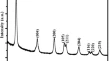
The epitaxial relationship between the InAs NWs and Si (111) substrate and the predominant crystal structure of these NWs were analyzed by XRD and TEM (Figure 3). The out-of-plane symmetric XRD 2θ − ω scan shown in Figure 3a, which was obtained from the as-grown NWs, indicates that NWs were grown epitaxially on the Si substrate. Besides the <111> reflection of Si at 28.4°, another reflection at 25.4° represented (111) of InAs. The weak peak of Si (111) may be due to not compensating for the 3.28° miscut of the Si substrate. Representative high-resolution TEM (HRTEM) images of these nanowires are presented in Figure 3b,c. Stripes with different contrast are observed along the nanowires. Careful analysis indicates that these correspond to the twin defects perpendicular to the growth axis. The detail of such defect is presented in Figure 3b. Figure 3c shows the HRTEM image of a NW with its inset showing the fast Fourier transform (FFT) image. The HRTEM image combined with the FFT image indicates that the InAs NW has a cubic, zinc-blende structure and grows along the <111> direction normal to the Si (111) substrate. The growth axis remains parallel to the (111) B direction.
Figure 3. XRD scan, low-resolution TEM, and HRTEM of a selected InAs nanowire array sample. (a) XRD scan of a selected InAs nanowire array sample, confirming the epitaxial relationship
between InAs (111) and Si (111) substrate. (b) Low-resolution TEM image of the nanowire. (c) HRTEM image of a portion of the nanowire. The inset of (c) shows the fast Fourier
transform of the selected area, which is viewed along the [0–11] direction.
Prior to the Raman investigations on single InAs NWs, scanning electron microscopy (SEM) measurements were performed in order to determine the shape, diameter, and length of the NWs after transfer (Figure 4a). The SEM image of InAs NWs transferred to the HOPG substrate shows that the NWs are monodisperse and well separated from each other. The NWs are 40 to 60 nm in diameter and up to 5 μm in length.
Figure 4. SEM image of InAs NWs, polarized Raman spectra, and azimuthal dependence of the TO
mode. (a) SEM image of InAs NWs transferred on a Si substrate. (b) Parallel polarized Raman spectra from a bulk InAs (110) and an InAs nanowire. For
both measurements, the exciting and scattered light are polarized along the <111>
direction. (c) A series of parallel and perpendicularly polarized Raman spectra obtained using
exciting light polarized parallel and perpendicular to the nanowire axis. The spectra
have been shifted vertically. (d) Azimuthal dependence of the TO mode related to the ZB structure in the nanowire.
Spheres and open squares represent the parallel and perpendicular components of the
Raman signal collected with respect to the nanowire axis, respectively. The continuous
line is a squared sine fit to the data.
Raman measurements were performed in a backscattering configuration on single InAs
NWs and from the (110) surface of a bulk InAs single crystal as reference. The general
measurement geometry for a single NW is shown in Figure 1. The laboratory coordinate system x, y, z is chosen according to the NW geometry and the basis of the NW crystal coordinate
system: (
For better understanding of phonon properties in single NWs, excitation polarization-dependent
Raman measurements were also performed on the single NWs. Figure 4c shows the Raman spectra of single NWs measured under four main polarization configurations
(
Conclusions
Raman scattering experiments have been performed on single InAs NWs. In the single NW spectra, a striking TO mode is observed at 215.8 cm−1, slightly lower than that of the reference bulk InAs (110) sample. This downward shift of the phonon frequency is mainly caused by defects or disorders that existed in the NW. The excitation polarization-dependent Raman measurements indicate that the TO phonon mode in the NW presents the highest scattering efficiency when both the incident and analyzed polarization are parallel to the NW growth axis. The TO mode of InAs NWs is found to act like a nearly perfect dipole antenna. This is a combined consequence of both the selection rules and the one-dimensional geometry of the NW.
Abbreviations
HRTEM: High-resolution transmission electron microscopy; LO: Longitudinal optical; MOCVD: Metalorganic chemical vapor deposition; NWs: Nanowires; SEM: Scanning electron microscopy; TO: Transverse optical; ZB: Zinc blende.
Competing interests
The authors declare that they have no competing interests.
Authors’ contributions
TFL carried out the experimental analysis and drafted the manuscript. WL and LZG participated in the experimental analysis. LJG participated in its design and coordination. YHC carried out the experimental design. TY and ZGW participated in the experimental design. All authors read and approved the final manuscript.
Acknowledgements
The authors would like to acknowledge Shuai Luo and Xiaoye Wang for their help with the MOCVD work. The work was supported by the 973 Program (no. 2012CB932701) and the National Natural Science Foundation of China (nos. 60990313, 60990315, and 21173068).
References
-
Yan RX, Gargas D, Yang PD: Nanowire photonics.
Nature Photonics 2009, 3:569. Publisher Full Text
-
Lu W, Lieber CM: Semiconductor nanowires.
J Phys D 2006, 39:R387. Publisher Full Text
-
Li Y, Qian F, Xiang J, Lieber CM: Battery betters performance energy generation.
-
Wei W, Bao XY, Soci C, Ding Y, Wang ZL, Wang DL: Direct heteroepitaxy of vertical InAs nanowires on Si substrates for broad band photovoltaics and photodetection.
Nano Lett 2009, 9:2926. PubMed Abstract | Publisher Full Text
-
Adachi S: Properties of Group-IV, III-V and II-VI Semiconductors. New York: Wiley; 2005.
-
Dayeh SA, Aplin D, Zhou XT, Yu PKL, Yu ET, Wang DL: High electron mobility InAs nanowire field-effect transistors.
Small 2007, 3:326. PubMed Abstract | Publisher Full Text
-
Jiang XC, Xiong QH, Nam SW, Qian F, Li Y, Lieber CM: InAs/InP radial nanowire heterostructures as high electron mobility devices.
Nano Lett 2007, 7:3214. PubMed Abstract | Publisher Full Text
-
Dick KA, Caroff P, Bolinsson J, Messing ME, Johansson J, Deppert K, Wallenberg LR, Samuelson L: Control of III-V nanowire crystal structure by growth parameter tuning.
Semicond Sci Technol 2010, 25:024009. Publisher Full Text
-
Hsu YF, Xi YY, Tam KH, Djurisic AB, Luo JM, Ling CC, Cheung CK, Ng AMC, Chan WK, Deng X, Beling CD, Fung S, Cheah KW, Fong PWK, Surya CC: Undoped p-type ZnO nanorods synthesized by a hydrothermal method.
Adv Funct Mater 2008, 18:1020. Publisher Full Text
-
Xiong QH, Wang J, Eklund PC: Coherent twinning phenomena towards twinning superlattices in III-V semiconducting nanowires.
Nano Lett 2006, 6:2736. PubMed Abstract | Publisher Full Text
-
Algra RE, Verheijen MA, Borgstrom MT, Feiner LF, Immink G, Enckevort WJP, Vlieg E, Bakkers EPAM: Twinning superlattices in indium phosphide nanowires.
Nature 2008, 456:369. PubMed Abstract | Publisher Full Text
-
Cardona M, Guntherodt G: Light Scattering in Solids II: Basic Concepts and Instrumentation. Berlin: Springer; 1982.
-
Adu KW, Gutierrez HR, Kim UJ, Sumanasekera GU, Eklund PC: Confined phonons in Si nanowires.
Nano Lett 2005, 5:409. PubMed Abstract | Publisher Full Text
-
Adu KW, Xiong Q, Gutierrez HR, Chen G, Eklund PC: Raman scattering as a probe of phonon confinement and surface optical modes in semiconducting nanowires.
Appl Phys A: Mater Sci Process 2006, 85:287. Publisher Full Text
-
Zardo I, Conesa-Boj S, Peiro F, Morante JR, Arbiol J, Uccelli E, Abstreiter G, Morral AF: Raman spectroscopy of wurtzite and zinc-blende GaAs nanowires: polarization dependence, selection rules, and strain effects.
-
Frechette J, Carraro C: Diameter-dependent modulation and polarization anisotropy in Raman scattering from individual nanowires.
-
Chen G, Wu J, Lu QJ, Gutierrez HR, Xiong QH, Pellen ME, Petko JS, Werner DH, Eklund PC: Optical antenna effect in semiconducting nanowires.
Nano Lett 2008, 8:1341. PubMed Abstract | Publisher Full Text
-
Xiong Q, Chen G, Gutierrez HR, Eklund PC: Raman scattering studies of individual polar semiconducting nanowires: phonon splitting and antenna effects.
Appl Phys Mater Sci Process 2006, 85:299. Publisher Full Text
-
Livneh T, Zhang J, Cheng G, Moskovits M: Polarized Raman scattering from single GaN nanowires.
-
Li TF, Chen YH, Lei W, Zhou XL, Luo S, Hu YZ, Wang LJ, Yang T, Wang ZG: Effect of growth temperature on the morphology and phonon properties of InAs nanowires on Si substrates.
Nanoscale Res Lett 2011, 6:463. PubMed Abstract | BioMed Central Full Text | PubMed Central Full Text
-
Begum N, Bhatti AS, Jabeen F, Rubini S, Martelli F: Line shape analysis of Raman scattering from LO and SO phonons in III-V nanowires.
J Appl Phys 2009, 106:114317. Publisher Full Text
-
Moller M, Lima MM, Cantarero A, Dacal LCO: Polarized and resonant Raman spectroscopy on single InAs nanowire.
-
Hormann NG, Zardo I, Hertenberger S, Funk S, Bolte S, Doblinger M, Koblmuller G, Abstreiter G: Effects of stacking variations on the lattice dynamics of InAs nanowires.
-
Yu PY, Cardona M: Fundamentals of Semiconductors. Berlin: Springer; 2005.
-
Wu J, Zhang D, Lu Q, Gutierrez HR, Eklund PC: Polarized Raman scattering from single GaP nanowires.
-
Yazji S, Zardo I, Soini M, Postorino P, Morral AFI, Abstreiter G: Local modification of GaAs nanowires induced by laser heating.
Nanotechnology 2011, 22:325701. PubMed Abstract | Publisher Full Text
-
Soini M, Zardo I, Uccelli E, Funk S, Koblmuller G, Morral AFI, Abstreiter G: Thermal conductivity of GaAs nanowires studied by micro-Raman spectroscopy combined with laser heating.
Appl Phys Lett 2010, 97:263107. Publisher Full Text
-
Gupta R, Xiong Q, Adu CK, Kim UJ, Eklund PC: Laser-induced Fano resonance scattering in silicon nanowires.
Nano Lett 2003, 3:627. Publisher Full Text
-
Piscanec S, Cantoro M, Ferrari AC, Zapien JA, Lifshitz Y, Lee ST, Hofmann S, Robertson J: Raman spectroscopy of silicon nanowires.
-
Adu KW, Gutierrez HR, Kim UJ, Eklund PC: Inhomogeneous laser heating and phonon confinement in silicon nanowires: a micro-Raman scattering study.
-
Lei W, Chen YH, Xu B, Ye XL, Zeng YP, Wang ZG: Raman study on self-assembled InAs/InAlAs/InP(001) quantum wires.
-
Campbell IH, Fauchet PM: The effect of microcrystal size and shape on the one phonon Raman spectra of crystalline semiconductors.
Solid State Commum 1986, 58:739. Publisher Full Text
-
Duesberg GS, Loa I, Burghhard M, Syassen K, Roth S: Polarized Raman spectroscopy on isolated single-wall carbon nanotubes.
Phys Rev Lett 2000, 85:5436. PubMed Abstract | Publisher Full Text
-
Rafailov PM, Thomsen C, Gartsman K, Kaplan-Ashiri I, Tenne R: Orientation dependence of the polarizability of an individual WS2 nanotube by resonant Raman spectroscopy.
-
Wang JF, Gudiksen MS, Duan XF, Cui Y, Lieber CM: Highly polarized photoluminescence and photodetection from single indium phosphide nanowires.
Science 2001, 293:1455-1457. PubMed Abstract | Publisher Full Text