Nano Express
Rolled-up tubes and cantilevers by releasing SrRuO3-Pr0.7Ca0.3MnO3 nanomembranes
1 Laboratorio Nacional de Nanotecnologia, Rua Giuseppe Máximo Scolfaro 10000, Campinas, São Paulo, 13083-100, Brazil
2 Institute for Integrative Nanosciences, IFW Dresden, Helmholtzstrasse 20, Dresden, 01069, Germany
3 Institute for Metallic Materials, IFW Dresden, Helmholzstrasse 20, Dresden, 01069, Germany
4 Institute of Microstructure Technology (IMT), Karlsruhe Institute of Technology (KIT), Hermann-von-Helmholtz-Platz 1, Eggenstein-Leopoldshafen, 76344, Germany
5 Departamento de Física, Universidade Federal de Minas Gerais, CP 702, Belo Horizonte, Minas Gerais, 30123-970, Brazil
6 Institute for Physics, Martin Luther University (MLU) Halle-Wittenberg, Von-Danckelmann-Platz 3, Halle, 06120, Germany
Nanoscale Research Letters 2011, 6:621 doi:10.1186/1556-276X-6-621
Published: 7 December 2011Abstract
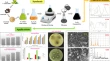
Three-dimensional micro-objects are fabricated by the controlled release of inherently strained SrRuO3/Pr0.7Ca0.3MnO3/SrRuO3 nanometer-sized trilayers from SrTiO3(001) substrates. Freestanding cantilevers and rolled-up microtubes with a diameter of 6 to 8 μm are demonstrated. The etching behavior of the SrRuO3 film is investigated, and a selectivity of 1:9,100 with respect to the SrTiO3 substrate is found. The initial and final strain states of the rolled-up oxide layers are studied by X-ray diffraction on an ensemble of tubes. Relaxation of the sandwiched Pr0.7Ca0.3MnO3 layer towards its bulk lattice parameter is observed as the major driving force for the roll-up of the trilayers. Finally, μ-diffraction experiments reveal that a single object can represent the ensemble proving a good homogeneity of the rolled-up tubes.
PACS: 81.07.-b; 68.60.-p; 68.37.Lp; 81.16.Dn.